Blog
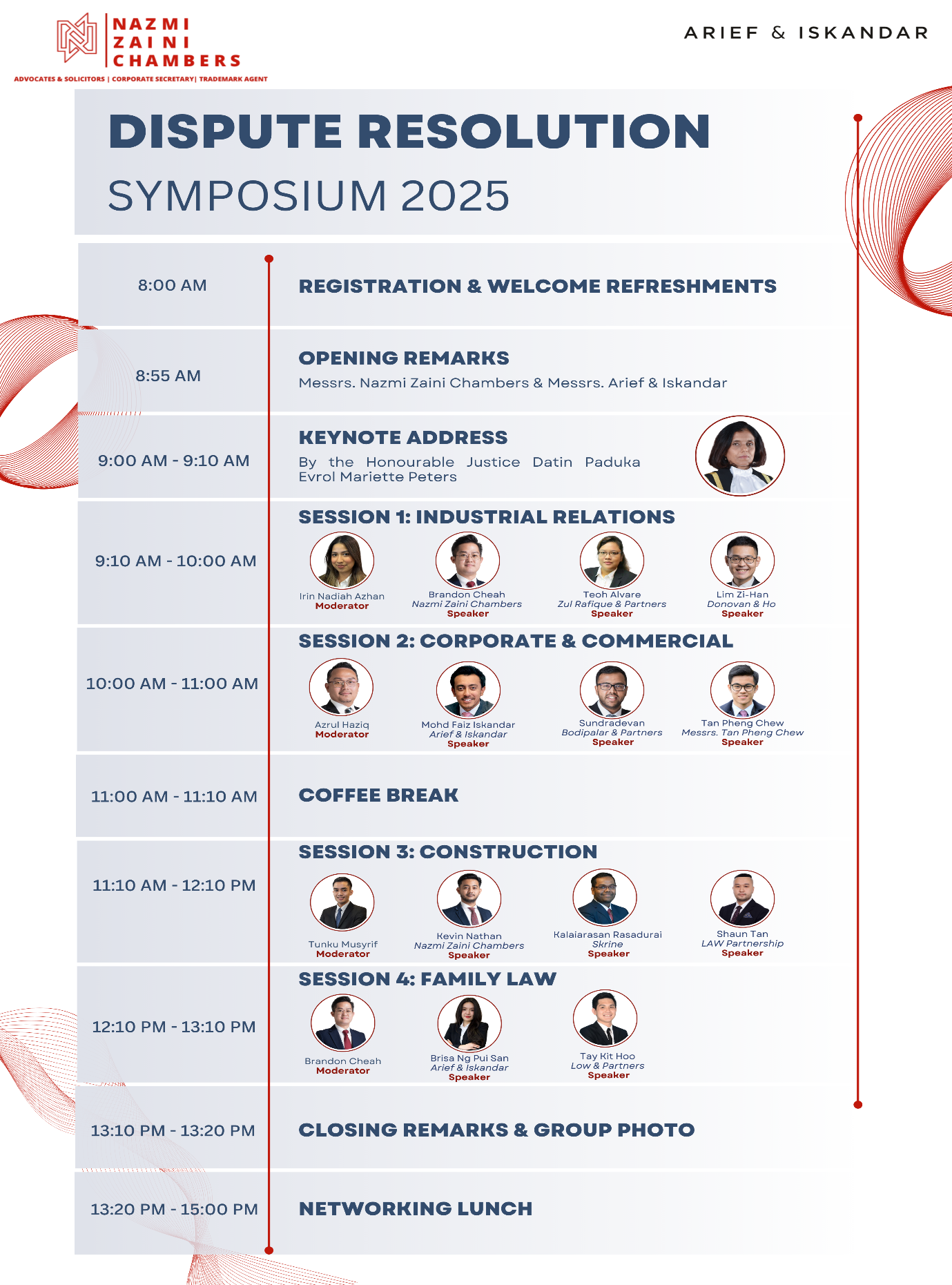
Keynote Address: The Case for Alternative Dispute Resolution (ADR)
By the Honourable Justice Datin Paduka Evrol Mariette Peters

Introduction to Dispute Resolution
In today’s world, disputes are an inevitable part of human interactions, arising in business transactions, family matters, neighbourhood conflicts, and even among strangers. The manner in which we resolve these disputes reflects our values and significantly impacts the peace and justice we experience. Not every dispute belongs in a courtroom. While courts are essential for delivering justice, they involve formalities, costs, delays, and emotional strain that may not always serve the best interests of the parties involved.
Key Takeaways
- ADR offers efficient alternatives to litigation, including negotiation, mediation, conciliation, and arbitration.
- ADR aims for constructive solutions, preserving relationships, dignity, and time.
- Not all disputes are best resolved in court; litigation should be reserved for cases requiring legal clarification or where other methods fail.
- ADR empowers parties to control outcomes and is encouraged in both family and business conflicts.
The Role of Alternative Dispute Resolution (ADR)
Alternative Dispute Resolution (ADR) offers a wiser, more compassionate, and often more effective approach to conflict resolution. Far from being a second-class form of justice, ADR prioritizes dignity, time efficiency, relationship preservation, and forward progress. ADR encompasses various methods, including negotiation, conciliation, mediation, early neutral evaluation, ombudsman services, and arbitration. These methods focus on constructive dialogue and practical solutions, empowering the parties most affected by the conflict to shape their own outcomes, rather than relinquishing control to a judge unfamiliar with their circumstances.
Benefits of ADR in Different Contexts
In family disputes, mediated settlements can foster understanding and cooperation, enabling healing in ways that court orders cannot. For example, a mediated agreement shaped by both parties’ voices can lay the foundation for future collaboration. In business conflicts, negotiated resolutions preserve commercial relationships and reputations, avoiding the destructive consequences of public litigation. While litigation remains necessary in cases requiring legal clarification or when one party refuses to engage reasonably, it is often pursued due to a lack of awareness about ADR alternatives.
A Call for Cultural Change
There is a pressing need to promote a culture where settlement is viewed as a sign of wisdom, not weakness. By encouraging dialogue, active listening, and the search for common ground, we can reserve court resources for cases that truly require judicial intervention. A poignant example is a matrimonial dispute in Family Court where a husband and wife, having resolved all issues except the ownership of a shared telephone number registered to their joint company, insisted on a full trial. This case illustrates how stubbornness can lead to wasted time, money, and resources, underscoring the value of exploring ADR before escalating conflicts.
Practical Advice for Litigants
Before pursuing litigation, individuals should ask themselves: Is there another way? Is there a better way? A way that brings closure rather than just a verdict? In most cases, the answer is yes. By choosing mediation, negotiation, or other ADR methods, parties can prioritize communication over confrontation, listening over accusing, and collaboration over conflict. Justice is not confined to courtrooms; it often begins with a conversation.
Closing Remarks
The root of most disputes lies in miscommunication or a lack of communication altogether. By fostering open dialogue, ADR can address conflicts with humanity, speed, and dignity.
Session 1: Industrial Relations

In contrast to Singapore’s more flexible termination framework, Malaysia’s employment laws require that any dismissal be based on “just cause or excuse.” While employers in Singapore can terminate employees with notice and without providing specific reasons, Malaysian law mandates both substantive justification and procedural fairness in dismissals.
This session, featuring expert insights from Mr. Brandon Cheah (Nazmi Zaini), Mrs. Alvare (Zul Rafiq), and Mr. Zihan (Donovan & Ho), focused on the four principal grounds for dismissal under Malaysian law: misconduct, poor performance, redundancy, and mutual separation. Among these, misconduct was given particular emphasis, highlighting its complexity and the importance of due process.
Key Takeaways
- Just Cause or Excuse: Malaysia’s termination laws require substantive grounds and procedural fairness, unlike Singapore’s notice-based system.
- Grounds for dismissal: Misconduct, poor performance, redundancy, and mutual separation.
- Misconduct Variability: From gossip to harassment to abusing medical leave, misconduct must align with company policy breaches, with employers bearing the burden to prove reasonable belief and action.
- Procedural Fairness: Employers must act reasonably and follow procedural fairness, including issuing show-cause letters and conducting domestic inquiries. No legal requirement for “three warning letters” before dismissal if just cause is established.
- PIP Rigor: Performance Improvement Plans (PIP) must be fair, with clear goals and timelines, to avoid claims of constructive dismissal.
- Genuine Redundancy: Retrenchment hinges on proving a role’s obsolescence, not just financial struggles, with fair selection criteria like Last-In-First-Out (LIFO).
- Hybrid Work Policies: Clear policies are essential to manage misconduct and productivity in remote settings.
- Social Media Risks: Companies must proactively educate employees and respond professionally to public breaches to mitigate reputational harm.
- AI and Redundancy: AI-driven role elimination can justify retrenchment if genuine redundancy is proven, but fairness in process remains critical.
Key Points from the Discussion
Just Cause or Excuse Principle
In Malaysia, employers must provide valid grounds for termination, adhering to the principle of “just cause or excuse.” This involves:
- Substantive Grounds: Legitimate reasons such as misconduct or poor performance.
- Procedural Fairness: Following due process, including issuing show-cause letters and allowing employees to defend themselves.
Failure to comply risks unfair dismissal claims, which may lead to remedies like reinstatement or compensation (up to 24 months’ back wages for confirmed employees, 12 months for probationers, and one month’s salary per year of service). Claims must be filed within 60 days at the Industrial Relations Department, followed by a conciliation session. If unresolved, cases proceed to the Industrial Court.
Misconduct
Misconduct encompasses a wide range of behaviours breaching company policies or employment contracts. Examples include:
- Clear-Cut Misconduct: Drug use or drinking alcohol in the workplace (unless explicitly permitted by policy, e.g., in firms with after-hours bars).
- Workplace Gossip: A case was cited where an employee was dismissed for spreading false rumors about colleagues’ affairs, upheld as fair due to reputational damage.
- Sexual Harassment: In a case of Loganathan Maniam v Murphy Sarawak Oil Co Ltd [2020] 2 ILR 275, a superior’s inappropriate behaviour (calling a secretary “sayang,” unwanted physical contact, and giving unsolicited gifts like lotion and perfume) led to a justified dismissal. The court ruled that terms like “sayang” imply intimacy and are unprofessional.
- Abuse of Medical Leave: In Che Zamberi bin Che Ani v. MAB Kargo Sdn. Bhd. [Award No. 378 of 2025, Case No. 10(5)/4-649/22, 5 March 2025], the Industrial Court upheld the dismissal of an employee for abusing medical leave. The employee, caught on surveillance playing sepak takraw, climbing a tree, and using a chainsaw during approved medical leave from May 22 to September 21, 2021, following a road accident, was found guilty of malingering. The court ruled that such misconduct, inconsistent with recovery, constituted a serious breach of trust, justifying termination
Employers must prove they acted reasonably in believing misconduct occurred and in dismissing the employee, without needing court-level evidence (e.g., CCTV for harassment). A show-cause letter and, if habitual, suspension or domestic inquiry are recommended to ensure natural justice.
Poor Performance and Performance Improvement Plans (PIPs)
PIPs are used to address poor performance, typically spanning two to three months. Courts scrutinize PIPs to ensure they are genuine and not designed to “set employees up to fail.” A PIP must include:
- A clear problem statement identifying areas for improvement.
- A reasonable timeframe (e.g., 3–6 months).
- Specific, achievable goals or KPIs.
- Consequences for non-compliance (e.g., warning or dismissal).
For dismissal based on poor performance, employers must demonstrate:
- Notification of performance issues.
- Provision of reasonable time and tools for improvement.
- Continued failure to improve despite support.
A 2015 case (Wong Pao Hin v. Philip Morris Malaysia Sdn Bhd 2 ILR 12) showed that placing an employee on a PIP without evidence of poor performance can lead to claims of constructive dismissal. Subjective performance issues (e.g., behaviour) are harder to prove than objective metrics (e.g., sales targets).
Retrenchment and Genuine Redundancy
Retrenchment requires “genuine redundancy,” where an employee’s role is no longer needed or is surplus to requirements. Economic downturns alone (e.g., low profits) are insufficient; employers must show how business conditions reduced the need for specific roles. Examples include:
- Business Downturn: A cheese import company saw reduced demand during COVID, diminishing the need for sales staff.
- Outsourcing: In Chen Xiao Ling v. Worley Parsons, outsourcing payroll to a more efficient service provider justified redundancy of in-house HR staff.
Selection for retrenchment should follow fair criteria, such as the Last-In-First-Out (LIFO) principle, performance evaluations, or prioritizing foreign workers. Courts emphasize “just cause or excuse” through genuine redundancy.
Hybrid Working and Evolving Workplaces
Hybrid and work-from-home arrangements, formalized in Malaysia’s Employment Act amendments of 2023, require clear company policies. These should outline:
- Expected behaviours (e.g., logging in/out, attending meetings).
- Monitoring mechanisms (with employee consent).
- Task completion requirements.
Employers must balance flexibility with accountability to prevent issues like employees shopping during work hours. Overworking employees in hybrid setups can lead to harassment claims. While employees can request flexible arrangements, employers may reject requests with reasonable justification (e.g., a security guard or receptionist cannot work remotely).
Social Media and Confidentiality
Gen Z’s vocal social media presence poses challenges when employees post internal documents (e.g., show-cause letters) or workplace complaints online. Such actions can cause reputational damage, even without naming the company, as seen in a case involving Farah Tina, where a Facebook post criticizing the company led to a justified dismissal. Companies should:
- Implement clear social media policies outlining permissible and prohibited content.
- Educate employees on confidentiality.
- Issue professional holding statements and conduct internal investigations if breaches occur.
Q&A Highlights
- Absence Without Reason: Under Section 15 of the Employment Act, absence for two or more consecutive days without reason constitutes a breach of contract. However, issuing a show-cause letter is recommended to ensure due process.
- Termination via WhatsApp: Termination via WhatsApp is acceptable only if it includes clear reasons; otherwise, it risks being deemed unfair.
- AI and Disguised Terminations: AI-driven automation may lead to role redundancy. If a role is significantly diminished by AI (e.g., software replacing manual tasks), it can qualify as genuine redundancy, provided employers demonstrate the AI’s efficiency and the reduced need for the role.
The session underscored the importance of clear policies, due process, and proactive communication to navigate Malaysia’s industrial relations landscape effectively.
Session 2: Corporate & Commercial

The Corporate & Commercial session, moderated by Azrul Haziq, featured practitioners Mr. Faiz (Arief & Iskandar), Mr. Sundra (Bodipalar & Partners), and Mr. Peng Chiew (Tan Pheng Chew), explored directors’ duties, liabilities, and emerging challenges in corporate governance. The discussion was structured in three rounds: regulatory duties and daily decision-making, directors’ roles in financial distress, and the expanding liability framework for non-executive and shadow directors.
Key Takeaways
- Directors’ Duties Are Non-Negotiable: Directors, including Non-Executive Directors (NED) and shadow directors, face strict statutory (e.g., Income Tax Act, Companies Act) and fiduciary duties, with no exemption for “silent” or nominal roles.
- Regulatory Compliance: Timely, accurate disclosures to LHDN and SSM, along with compliance with Industrial Court awards, are critical to avoid fines, imprisonment, or personal liability.
- Financial Distress and Creditor Duty: Directors must prioritize creditors’ interests when insolvency looms, avoiding transactions (e.g., dividends, fund transfers) that benefit themselves over the company.
- Shadow Directors: Influence, not title, determines liability. Email trails, board minutes, and instructions can establish shadow directorship, as seen in the 1MDB case.
- Willful Blindness: Ignoring suspicious transactions risks severe penalties under the Companies Act and AMLA. Directors must proactively investigate and report.
- Contractual and Competitive Liability: Directors acting beyond authority or breaching non-conflict clauses face personal liability, particularly if motivated by personal gain.
- Governance Is Key: Well-documented deliberations, independent advice, and transparent decision-making protect directors from liability.
Key Points from the Discussion
Round 1: Regulatory Duties and Daily Decision-Making
Directors, as the “mind and will” of a company, bear significant statutory and fiduciary duties under Malaysian law, particularly when interacting with regulators like the Inland Revenue Board (LHDN) and Companies Commission of Malaysia (SSM). Key points include:
- Statutory Duties under the Income Tax Act:
- Section 112: Failure to file a tax return can result in fines up to RM20,000, imprisonment, and a penalty three times the tax payable.
- Section 113: Incorrect tax returns may lead to fines up to RM10,000 and a penalty equal to the undercharged tax.
- Section 75A: Directors with at least 20% shareholding are jointly and severally liable for tax non-compliance. LHDN can issue stoppage orders (Section 104) to prevent directors from leaving Malaysia or pursue civil action, potentially leading to bankruptcy.
- SSM Compliance: Similar civil and criminal actions apply for non-compliance with SSM requirements.
- Industrial Court Awards: Directors must ensure compliance with Industrial Court awards. A case involving a foreign company’s Malaysian associate (Company B) saw six employees awarded RM8.8 million. Non-compliance led to two directors (with only 0.0001% shareholding) facing charges, fines up to RM20,000, and a RM500 daily penalty since 2019, accumulating approximately RM3 million. Another case, Masyong Mutiara v. Public Prosecutor, resulted in a RM1 million penalty for 2,100 days of non-compliance with a RM40,000 award.
- Example of Oversight: Minor oversights, such as failing to file accurate tax returns or ignoring court awards, can escalate into severe financial and legal repercussions, including personal liability and travel bans.
Round 2: Directors in Financial Distress
Directors’ duties shift when a company faces financial distress, particularly regarding creditors’ interests. Key insights include:
- General Duty: Directors owe duties to the company, not creditors, under normal circumstances. However, the Singapore Court of Appeal case Fook Kian Beng v. OP3 International (2024) established a creditor duty when a company is financially distressed or insolvent. In this case, a director (also the sole shareholder) declared a RM2.8 million dividend and repaid himself RM820,000 in loans during financial distress, breaching fiduciary duties by prioritizing personal gain over the company’s interests.
- Creditor Duty Scope: Directors must consider creditors’ interests when insolvency is foreseeable, evaluating:
- The company’s financial performance (improving or deteriorating).
- Industry prospects.
- Geopolitical factors.
- Regulator Assessment: Bursa Malaysia and SSM require timely, accurate disclosures of material information (e.g., transactions, litigation, shareholder changes). Directors must maintain well-documented board deliberations, seek independent professional advice, and ensure transparency to demonstrate compliance. In the Serverdynamic case, directors and officers were charged for falsifying a RM6.014 billion revenue figure, resulting in a RM16 million compound penalty.
Round 3: Expanding Liability Framework
The session addressed liabilities for non-executive directors (NEDs) and shadow directors, emphasizing that no director is exempt from responsibility.
- Non-Executive Directors (NEDs):
- NEDs provide oversight and may chair committees (e.g., audit committees), with heightened expectations in their assigned areas. Failure to detect irregularities (e.g., suspicious transactions) can lead to liability under Section 213 of the Companies Act 2016, with penalties up to 5 years’ imprisonment or a RM3 million fine.
- NEDs are held to the same fiduciary standards as executive directors, particularly in oversight roles.
- Shadow Directors:
- A shadow director is someone not formally appointed but who exerts significant influence over the board, acting as the “commanding mind.” The Companies Act 2016 (Section 2) defines a director as anyone whose instructions the board habitually follows, regardless of title.
- Malaysian cases recognizing shadow directors include Sazian Engineering Constructions Sdn Bhd v. United Natural Resources and Public Prosecutor v. Dato’ Sri Najib Razak, where Najib was held accountable as a shadow director for influencing 1MDB decisions.
- The 1MDB case highlighted Jho Low’s role as a shadow director, orchestrating a RM1 billion USD transaction with Petro Saudi, where RM700 million was diverted to his company, Goodstar Limited, despite not holding a formal directorship. Email trails and approvals evidenced his control.
- Shadow directors face the same liabilities as formal directors, with regulators focusing on conduct (board minutes, emails, instructions) rather than titles.
- Personal Liability for Contracts:
- Directors are generally not personally liable for company contracts unless they act improperly or beyond their authority. Examples include:
- Entering contracts for personal gain (e.g., securing commissions or assets).
- Defrauding creditors by entering contracts the company cannot fulfill.
- Courts apply an objective test to assess directors’ intentions, holding them liable for breaching fiduciary duties if personal benefit is prioritized (Fook Kian Beng v. OP3 International).
- Directors are generally not personally liable for company contracts unless they act improperly or beyond their authority. Examples include:
- Willful Blindness:
- Directors who ignore suspicious transactions risk liability for willful blindness, defined in Kowalpio v. Amahis Kandahar (citing Professor Glanville Williams) as deliberately avoiding confirmation of suspected facts to deny knowledge.
- In a case involving a police officer, failure to investigate a RM9 million deposit (against a RM5,000–6,000 income) led to liability under the Anti-Money Laundering Act (AMLA). Directors must:
- Inspect accounting records (absolute right under Section 245(4) of the Companies Act, per Datuk Tan Kim Hall v. Tan Chong Consolidated Sdn Bhd).
- File a Suspicious Transaction Report (STR) to the Financial Investigation Enforcement if money laundering is suspected.
- Failure to act risks penalties under Section 213 (breach of duties) or Section 52(1)(bb) of AMLA, including business seizure or bans on directors’ involvement.
- Non-Conflict Clauses:
- Non-conflict clauses prevent directors from engaging in activities that conflict with the company’s interests, such as joining a competitor or exploiting trade secrets post-resignation.
- Enforceability depends on the director’s intent and the clause’s scope (e.g., time limits of 6 months to 2 years). Courts assess whether resignation was motivated by plans to compete.
- Breaching fiduciary duties post-resignation can lead to liability if the director’s actions harm the company.
Q&A Highlights
- Other Breaches of Creditor Duty:
- Beyond dividends or loan repayments, moving funds to a related company (where the director is a shareholder) can breach creditor duty if it prioritizes personal gain over the company’s interests (Fook Kian Beng v. OP3 International).
- NED Liability:
- NEDs, especially those overseeing audits, can be liable under Section 213 for failing to detect irregularities within their purview, subject to the business judgment rule (i.e., whether they considered all relevant factors).
- Derivative Actions:
- Shareholders cannot sue directors directly but must pursue derivative actions under Section 340 of the Companies Act, where the company is the plaintiff. This addresses breaches of duty, with remedies like buyouts for oppression (Lee Wang Sing’s input).
Session 3: Construction

The Construction session, moderated by Tunku Musyrif, featured experts Shaun Tan (LAW Partnership), Kalai (Skrine), and Kevin Nathan (Nazmi Zaini). The discussion focused on disputes in construction projects, covering all scales from small renovations to mega infrastructure projects like the ECRL and Kota Madani (valued at RM4 billion). The session was divided into two parts: identifying disputes across project stages (pre-commencement, execution, and post-commencement) and exploring dispute resolution methods, particularly adjudication under the Construction Industry Payment and Adjudication Act 2012 (CIPAA), arbitration, and civil litigation.
Key Takeaways
- Dispute Stages: Disputes arise at pre-commencement (e.g., soil investigation, contract ambiguities, site handover delays), execution (e.g., payment delays, variation orders, EOT/LAD issues), and post-commencement (e.g., defects, final account disputes).
- Payment Disputes Dominate: Delayed payments and valuation of variations are the most common issues, exacerbated by contractors’ limited bargaining power.
- CIPAA’s Superpowers: Fast, document-based adjudication with suspension rights, direct payment options, and winding-up leverage makes CIPAA ideal for payment disputes.
- Arbitration for Complexity: Offers confidentiality, expertise, and international enforceability but is costly and time-consuming.
- Litigation’s Trade-Offs: Low-cost but public and slower, suitable for broad disputes but less ideal for urgent or sensitive cases.
- Contract Clarity: Clear provisions for EOT, loss and expense, and variation valuations reduce disputes.
- Subcontractor Challenges: Privity limits direct claims against employers, except in insolvency cases via unjust enrichment.
Part 1: Disputes in Construction Projects
Pre-Commencement Disputes
Disputes often arise before construction begins due to issues in preparation and contracting:
- Soil Investigation: Shaun highlighted negligent soil investigations as a common issue, as seen in Resource Island Pte Ltd v. GeoSpecs Pte Ltd. Inaccurate soil data can lead to incorrect tender pricing, causing economic loss for contractors (e.g., piling contractors claiming extra damages).
- Contractual Ambiguities: Kalai pointed out the “elephant in the room”—unclear contract terms regarding stamp duties, authority levies (e.g., CIDB, town councils), and other payments. Failure to address these can disrupt project flow and lead to disputes.
- Delayed Site Handover: Kevin emphasized delays in handing over the site to contractors, which delay income (e.g., progress payments) while contractors incur ongoing overhead costs (e.g., site office, machinery). This can lead to claims for loss and expense due to extended overheads. Contracts should include mechanisms for Extension of Time (EOT) and provisions for claiming such costs to mitigate disputes.
Execution Stage Disputes
The execution phase, being the longest, is prone to numerous disputes:
- Payment Delays: Kalai identified delayed progress payments as the most common issue. Contractors, paid based on milestones, face financial strain if payments are late, yet contracts often limit remedies to interest, not allowing suspension, reduced progress, or termination. This creates a dilemma where contractors must continue work despite non-payment.
- Negligence and Performance Bonds: Shaun discussed employer responses to contractor negligence (e.g., defects, accidents), often covered by indemnity clauses. Employers may deduct from payments, tap retention sums, or call on performance bonds. Contractors can challenge bond calls only if the employer’s actions are unconscionable, but their bargaining power is typically limited due to employer-favoured contract terms.
- Variation Orders: Kevin noted that variation orders (changes to the original scope, such as increasing a room’s capacity from 180 to 300 pax) are a frequent dispute source. Key issues include:
- Scope Disputes: Determining if work is truly additional or ancillary (e.g., transportation of materials may be ancillary, not claimable as a variation).
- Procedural Issues: Variations require written orders, but courts may uphold claims based on parties’ conduct even without written instructions (Datuk Mary Lim’s judgment).
- Valuation Disputes: Lack of clear valuation methods (e.g., fair market value, Bill of Quantities rates, or Malaysian Standard Method of Measurement) leads to conflicts over costs.
- Extension of Time (EOT) and Liquidated Damages (LAD): Shaun and Kalai discussed EOT and LAD complexities. Contractors must meet preconditions (e.g., timely notices) for EOT eligibility. Unreasonable EOT refusals can render time “at large,” nullifying LAD claims. The UK Supreme Court case Triple Point clarified that LAD applies only up to contract termination, not completion. Overlapping delay events require expert analysis to apportion responsibility.
Post-Commencement Disputes
Post-construction disputes center on project closeout:
- Defects and Safety Penalties: Shaun noted that rectification of defects and penalties for safety regulation breaches are common, often offset against retention sums or final payments.
- Final Account Disputes: Kalai highlighted disputes over certified sums (subject to set-offs for LAD or other damages) and uncertified claims, culminating in final account disputes. These include loss and expense claims tied to EOT applications, requiring proper notices.
- Subcontractor Claims: Kevin addressed subcontractors’ inability to claim directly from employers due to privity of contract, except in cases of main contractor insolvency, where unjust enrichment (Section 71 of the Contracts Act) may allow claims against employers.
Part 2: Dispute Resolution Methods
Adjudication under CIPAA
Kalai described CIPAA as a “superhero” for its speed and effectiveness in resolving payment disputes:
- Key Features:
- Fast and Furious: Decisions within 106 working days, based on “rough justice” (pay now, argue later). Disputes are resolved via documents, with hearings rare (95–99% document-based).
- Scope: Limited to payment disputes in construction contracts, excluding damages claims.
- Superpowers:
- Suspension Rights: Section 29 allows contractors to suspend work or reduce progress if payments are delayed, with reasonable EOT granted post-payment.
- Direct Payment: Section 30 enables subcontractors to claim adjudicated amounts directly from employers if main contractors fail to pay, provided funds are owed to the main contractor.
- Concurrent Proceedings: CIPAA adjudication can run alongside arbitration or litigation.
- Winding-Up Leverage: Adjudication decisions can support winding-up notices, pressuring non-paying parties to settle within 21 days to avoid liquidation.
- Considerations: Moderate cost, high confidentiality, low evidentiary burden (no mandatory hearings), ideal for interim relief during ongoing projects.
- CIPA Amendments: Kalai, involved in amendments via the Bar Council, noted ongoing efforts to enhance CIPAA’s framework, though specifics were not detailed.
Arbitration
Shaun outlined arbitration as a robust option for complex disputes:
- Key Considerations:
- Cost and Time: High cost (arbitrator fees, admin costs) and longer duration (12–24 months, though fast-track options like summary dismissal or streamlined procedures can take 3–6 months).
- Confidentiality: Private proceedings, unlike public court filings.
- Expertise: Parties can appoint arbitrators with relevant expertise (e.g., engineers for technical disputes).
- Enforceability: Awards are enforceable internationally under the New York Convention (160+ signatories).
- When to Choose: Ideal for complex, non-payment disputes or when confidentiality and expertise are priorities. As adjudication awards risk being stayed if the claimant cannot repay, it makes arbitration a safer long-term option if financially viable.
Civil Litigation
Civil litigation’s pros and cons:
- Pros:
- Low Cost: Minimal filing fees compared to arbitration or CIPAA.
- Specialized Courts: KL’s construction courts offer expert judges, though not all states have them.
- Cons:
- Public Domain: Filings are accessible, potentially harming parties’ financial reputation (e.g., impacting loan applications).
- Time: Backlogs (e.g., 30 vacant High Court seats) cause delays.
- Scope: Covers all disputes (technical, payment, simple, or complex) with high evidentiary thresholds (balance of probabilities).
- When to Choose: Suitable for parties prioritizing cost over confidentiality, but less ideal for time-sensitive or reputation-sensitive disputes.
Q&A Highlights
- Subcontractor Termination under CIPAA: Kalai clarified that subcontractors can initiate CIPA for unpaid certified sums but not for damages from wrongful termination, emphasizing the need to define the claim’s nature.
Session 4: Family Law

The Family Law session, featuring Kit (Low & Partners) and Brisa (Arief & Iskandar), focused on mediation, divorce grounds, child custody, maintenance, matrimonial assets, and procedural safeguards, with an emphasis on Alternative Dispute Resolution (ADR) in family disputes. The discussion addressed practical challenges, legal frameworks under the Law Reform (Marriage and Divorce) Act 1976 (LRA), and the evolving nature of family law in Malaysia.
Key Takeaways
- Mediation’s Value: Encourages interest-based solutions but requires skilled mediators and willing parties.
- Grounds for Divorce: Unreasonable behaviour (including emotional abuse) and neglect qualify as proofs, with circumstantial evidence key for adultery.
- Child Custody: Prioritizes welfare, ignoring lifestyle unless it impacts parenting; siblings may be separated for individual needs.
- Maintenance Flexibility: Variations require proof of changed circumstances; remarriage affects spousal maintenance.
- Matrimonial Assets: Non-financial contributions are equally valued, with children’s needs prioritized in home allocation.
- Procedural Gaps: Joint petition safeguards are minimal, risking coercion without robust checks.
- Evolving Laws: The LRA balances traditional roles but needs data-driven updates for modern fairness.
Mediation in Family Disputes
- Mediation Overview: Kit emphasized mediation’s role in moving parties from rigid positions to underlying interests, using the “ugly orange” analogy: two parties fighting over an orange can resolve the dispute by addressing their interests (e.g., one needs the peel for baking, the other the pulp for juice), achieving a win-win outcome. Mediation is advisable for couples before divorce to foster constructive dialogue, but success depends on a skilled mediator who can navigate emotional barriers.
- Challenges: Clients often resist mediation due to entrenched positions or inability to communicate, seeking lawyers for solutions instead. Kit advocates mediation as a starting point to avoid litigation, but parties may revert to negotiation between lawyers if mediation fails.
Irretrievable Breakdown of Marriage
- Grounds for Divorce: The LRA recognizes irretrievable breakdown of marriage through four proofs: adultery, unreasonable behaviour, desertion, and living apart for two years. Kit highlighted:
- Unreasonable Behaviour: Subjective, based on what one spouse finds intolerable (e.g., a spouse’s persistent uncleanliness, like skid marks on underwear). Emotional abuse and neglect qualify as unreasonable behaviour under the Domestic Violence Act 1994, which includes emotional and financial abuse as domestic violence.
- Adultery: Proving adultery is challenging as it typically occurs privately. Courts rely on circumstantial evidence showing opportunity and likelihood (e.g., hotel records, frequent contact, photos indicating intimacy), as noted in Yang Ah Yu by Mary Peters. Expert reports are useful for proving damages from adultery, not the act itself.
- Case Example: In HRC v. PTL (2024), a post-nuptial agreement allowing the husband an extramarital partner meant adultery did not constitute a breakdown, as both parties consented.
Child Custody
- Best Interest of the Child: Courts prioritize the child’s welfare under Section 88 of the LRA, assessing each child’s needs individually. Factors like a parent’s lifestyle (e.g., provocative photos in Tang Heng Kit, partner-swapping in Tan Teh Eng Kim) are irrelevant unless they directly impair parenting ability. Relevant considerations include daily care, schooling, and work-life balance.
- Sibling Separation: Courts may separate siblings if it serves their individual best interests, considering emotional, physical, and financial needs. Child interviews or expert reports (e.g., from psychologists or welfare officers) may guide decisions.
- Third-Party Custody: Parents are preferred unless exceptional circumstances (e.g., abuse or neglect under the Child Act 2001) justify third-party custody (e.g., JKM officers or orphanages). In Law Siu Hong, courts prioritized parental custody over religious authorities’ claims. In ABC & JKL, biological parents retained custody over a biological father’s access claim.
Child and Spousal Maintenance
- Child Maintenance Variation: If a paying spouse loses their job or becomes ill, they cannot unilaterally stop payments but must apply for variation under the LRA, proving material change in circumstances, mistake, or misrepresentation. Courts consider the hardship’s genuineness, duration, the child’s needs, and both parents’ financial capacity. The child’s best interest remains paramount.
- Spousal Maintenance: Wives may claim maintenance under the LRA, but husbands face stricter criteria (Section 77), requiring proof of mental or physical incapacity (e.g., a stroke reducing income, as in a 2016 case where maintenance was reduced but not awarded to the husband). Remarriage by a receiving spouse (typically the wife) terminates maintenance, while a paying spouse’s remarriage may justify variation due to new financial obligations.
- Proactive Measures: Courts may grant separate education and medical maintenance (e.g., for international schooling) if requested, even if not explicitly provided in the LRA. Joint health funds or insurance are prudent but not mandatory.
Matrimonial Assets
- Non-Financial Contributions: Under Section 76 of the LRA (post-amendment), non-financial contributions (e.g., giving up a career, managing the household, raising children) are equally weighted with financial contributions. Courts start with a 50-50 split, adjustable based on evidence.
- Matrimonial Home: Courts prioritize children’s needs, potentially awarding the home to the custodial parent (typically the mother) to maintain stability, as in Qing Sheng Hua, where children’s welfare preceded asset division. However, this is discretionary, and Malaysia lacks UK-style protection orders to secure the home.
Procedural Safeguards in Joint Petitions
- Joint vs. Single Petitions: Joint petitions require mutual agreement on all issues (e.g., custody, maintenance, assets), while single petitions arise when parties disagree. Section 52 of the LRA mandates courts to ensure free consent in joint petitions, typically by requiring parties to confirm agreement in court. During COVID, exemptions allowed affidavits to bypass court appearances, raising enforcement risks if consent was coerced.
- Safeguards: Courts rely on minimal checks (e.g., verbal confirmation or affidavits), which may not fully prevent subtle coercion. Disputed joint petitions may lead to variation or enforcement proceedings.
Fairness and Relevance of Divorce Laws
- Evolving Laws: Kit noted that the LRA evolves with societal changes, balancing equal rights despite perceived biases (e.g., mothers presumed better carers for children under 7 per Section 88, stricter criteria for husbands’ maintenance per Section 77). These provisions reflect affirmative action for traditional roles, particularly outside urban areas like Klang Valley.
- Challenges: The LRA remains untranslated into Bahasa Malaysia, limiting accessibility. Without data-driven analysis, removing these provisions risks harming vulnerable groups (e.g., lower-income wives). Collaborative practice, involving mediators, mental health professionals, and financial experts, offers a holistic alternative to mediation but is costlier due to expert fees.
Q&A Highlights
- Tracking Assets: Discovering a spouse’s assets is challenging without court-ordered discovery (e.g., bank statements). Private investigators are an option, but success is not guaranteed. Parties must estimate assets or pursue litigation for transparency.
- Non-Payment of Maintenance: Enforcement options for unpaid child maintenance (e.g., RM2,000 of a RM3,000 order) include Judgment Debtor Summons, garnishment, or seizure and sale. Mediation or negotiation is preferred before escalation, and practitioners must follow divorce procedural rules to avoid dismissal.
- Handling Emotional Clients: Kit and Brisa recommended maintaining separate client and personal phones to manage boundaries. Emotional clients should be referred to counsellors or psychologists to avoid trauma-dumping, which also supports evidence for unreasonable behaviour or domestic violence claims.
Conclusion
The Dispute Resolution Symposium 2025 emphasized the transformative potential of Alternative Dispute Resolution (ADR) as a compassionate and effective alternative to traditional litigation. The keynote address highlighted that while courtrooms serve a critical role in delivering justice, they are often ill-suited for disputes where preserving relationships, dignity, and efficiency are priorities. ADR methods—such as negotiation, mediation, and arbitration—empower parties to craft their own solutions through dialogue, avoiding the adversarial nature of litigation.