Blog
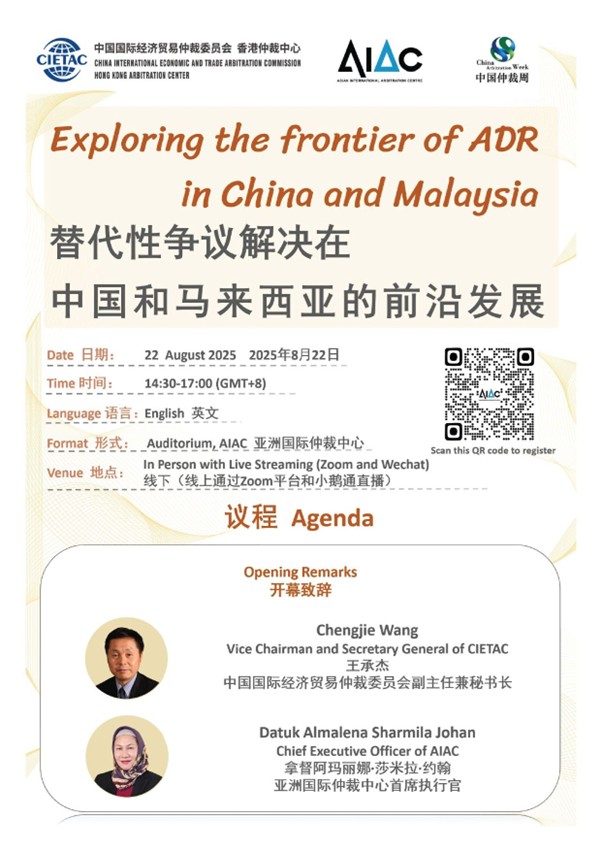
The event, co-hosted by the China International Economic and Trade Arbitration Commission (“CIETAC”), CIETAC Hong Kong Arbitration Centre, and the Asian International Arbitration Centre (“AIAC”) explored recent developments in alternative dispute resolution (“ADR”) frameworks, legislative reforms, best practices, and practical enforcement issues across China and Malaysia, with a focus on cross-border commercial disputes and regional cooperation.
Opening Remarks

The seminar is part of the 2025 China Arbitration Week
Mr. Chenjie Wang (Vice Chairman & Secretary General, CIETAC)
- Emphasized CIETAC’s growth into China’s most international arbitration body, handling 6,013 new cases in 2024 worth RMB 1.89 trillion.
- Highlighted CIETAC Hong Kong’s global role and the impact of judicial interpretations enabling cross-border arbitration with Hong Kong/Macau.
- Stressed the importance of China-Malaysia cooperation as Malaysia is China’s 2nd largest ASEAN trading partner.
- Introduced CIETAC’s new AI arbitration guidelines.
Datuk Amalena Sharmila Johan (CEO, AIAC)
- Framed the event as part of a deepening AIAC–CIETAC partnership, building on ASEAN–China ties.
- Linked ADR to Prime Minister Anwar Ibrahim’s “Unity in Diversity” vision, underlining inclusivity and growth in ASEAN dispute resolution.
- Acknowledged China’s Belt and Road role in fostering investment, trade, and digital development.
Session 1: Evolving ADR Legislation, Guidelines, and Practices in China and Malaysia
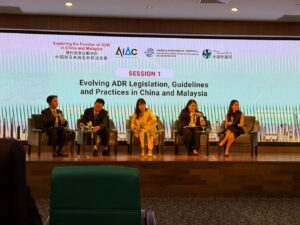
Moderated by Ms. Crystal Wong (Partner, LHAG), the session covered legislative amendments, soft law guidelines, and cultural nuances in ADR practices.
Malaysian Reforms by Ms. Tan Hui Wen, Partner at Jeff Leong, Poon & Wong
Ms. Tan outlined two major reforms: amendments to the Arbitration Act 2005 (gazetted November 2024, pending commencement) and AIAC restructuring. Key amendments include:
- Institutional updates: Replacing “Director of AIAC” with “President of the AIAC Court of Arbitration.”
- Arbitration agreements: Expanded to include “any other documents” for proof.
- Applicable law: Parties may agree on law; default is seat law, not main contract law.
- Arbitrator appointments: Joint appointments in multi-party cases.
- Hearings: Discretionary repetition upon replacement of arbitrators.
- Awards: Recognition of digital/electronic signatures; automatic binding of awards without court application (enforcement still requires application).
- Third-party funding (“TPF”): Permitted post-amendment; Minister may issue codes; mandatory disclosure; non-compliance effects outlined.
- Immunity: Extended to “any person” acting in good faith.
AIAC restructuring (via 2024 supplementary agreement) occurs in phases:
Phase 1 established a Board of Directors (April 2024) and CEO role (August 2024);
Phase 2 forms the AIAC Court of Arbitration (Pro Tem Committee submitted report). Rules remain AIAC Arbitration Rules 2023, with anticipated updates. Implications include enhanced clarity, efficiency, and institutional confidence, positioning Malaysia as a regional arbitration hub.
Chinese Reforms by Mr. Guowang Xie, Chief Partner at Beijing Jingyue Law Firm
People’s Republic of China (“PRC”) Arbitration Law faces it first major revision in 30 years, with drafts in 2023 and May 2025. Key proposals include removing pre-job training for arbitrators and challenging prosecutor eligibility. Suggestions adopted: Limiting administrative interference in arbitration; expanding foreign institutions’ scope beyond free-trade zones; shifting fee approvals to record-filing. Mr. Xie emphasized the law as a “game of power and interests,” reflecting broad stakeholder input from China’s 60,000 arbitrators and 3,400 foreign ones.
Observations on Chinese Reforms by Ms. Mariana Zhong, Partner at Hui Zhong Law Firm
Ms. Mariana compared 2021 (broader reforms) and 2024 (more conservative) drafts. Highlights:
- Ad hoc arbitration: 2021 lifted bans for foreign-related cases; 2024 requires institution designation but allows exceptions for maritime/free-trade zone disputes.
- Competence-competence: Both empower tribunals on jurisdiction, but 2024 retains court superiority.
- Interim measures: 2021 empowered tribunals (including emergency arbitration); 2024 reverts to courts only, though a Beijing court recently enforced a tribunal measure.
Reforms aim to make China more arbitration-friendly.
Soft Law Instruments by Mr. Matthew Suen, Barrister at Denis Chang’s Chambers
Soft law play a crucial role in Hong Kong/ international arbitrations for document production and privilege, balancing differing legal traditions.
Mr. Suen focused on International Bar Association (“IBA”) Rules on Taking of Evidence (emphasizing discretionary privilege assessments for fairness) and CIETAC’s July 2025 AI guidelines. The latter warn of risks (e.g., confidentiality breaches), emphasize tribunals’ non-delegable duties, and recommend party consultations on AI use, promoting party autonomy.
Closing Advice
- Ms. Tan: Emphasize mediation/conciliation; foster cross-system understanding.
- Ms. Mariana: Note Malaysian law’s unconscionability test aiding Chinese contractors; anticipate growing disputes.
- Mr. Xie: Promote ADR as economic soft power; invite collaboration.
- Mr. Suen: Draft proper arbitration clauses using institutional models.
Session 2: Enforcement of Arbitral Awards in Cross-Border Trade and Investment Dispute
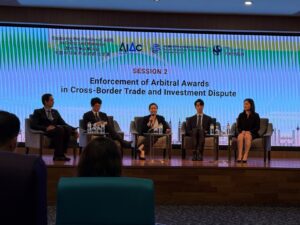
Moderated by Heather Yee (Assistant Director, AIAC), focusing on practical enforcement steps, timelines, costs, challenges, and cases amid Belt and Road influences.
Mainland China by Ms. Kelly Xiaoyu Zhang, Counsel at Jingcheng Tongda & Neal (Shenzhen) Law Firm
- Mainland China enforces ~95% of foreign arbitral awards (2023 figures).
- Enforcement mainly under New York Convention; special arrangements for Hong Kong, Macau, Taiwan.
- Challenges: service of documents, agreement validity, translation issues.
Greater Bay Area by Mr. Jingtao Ou, Counsel at CIETAC Hong Kong Arbitration Center
- Mutual arrangements mirror New York Convention standards.
- 2019 interim measures arrangement boosts Hong Kong-seated arbitrations.
- Language & notice practices critical to enforcement success.
Hong Kong by Mr. Wing So, Arbitrator/Barrister at Resolution Chambers
- Enforcement via New York Convention (6-year limit) or common law (costlier).
- Timeline: Weeks for registration; months if contested.
- Costs: Approx. HKD equivalent of MYR 50,000–80,000 for straightforward cases.
- Challenges: Service (upheld if contractual); notable cases (e.g., religious awards).
- Notable updates: Foreign state immunity allow enforcement against states.
Malaysia by Mr. Leonard Yeoh, Senior Partner at Tay & Partners
- Sections 38–39 of Arbitration Act 2005 apply.
- Post-amendment: awards are automatically binding (though still require enforcement proceedings).
- Reciprocal Enforcement of Judgments Act (“REJA”) provides a shortcut, e.g., ING Bank v. Tumpuan Megah Development Sdn Bhd (2025) (FC).
- Timeline: 2–3 months ex parte.
- Costs: Low court fees; variable legal fees.
- Challenges: procedural technicalities (translations, certification).
- Clear pro-arbitration stance demonstrated in International Centre for Settlement of Investment Disputes (“ICSID”) enforcement.
Q&A and Final Remarks
Discussions covered timelines (Enforcement in China: <1 year; Hong Kong/Malaysia: weeks–months), costs (court fees, legal fees), challenges (service, time bars), and cases (e.g., Hong Kong refusal for arbitrator misconduct; Malaysia for uncertified translations). Reforms boost confidence: Malaysia’s amendments/REJA; China’s reporting mechanism; Hong Kong’s interim measures; Greater Bay’s mutual arrangements.
Key Takeaways
- Embrace Reforms for Efficiency
- Malaysia’s TPF adoption and digital awards; China’s cautious liberalization.
- Modernization improves predictability, access, and global competitiveness.
- Prioritize Procedural Rigor
- Common pitfalls: improper service, uncertified translations.
- In cross-border ADR, “prevention through precision” avoids costly refusals.
- Leverage Soft Law & Technology Ethically
- IBA Evidence Rules + CIETAC AI guidelines balance innovation with fairness and confidentiality.
- Tribunals must consult parties before using AI; parties should draft AI-specific provisions.
- Foster Cross-Cultural Collaboration
- Malaysian unconscionability tests protect Chinese firms; mediation valued in both systems.
- “Unity in diversity”—ADR as a bridge between civil and common law systems.
- Navigate Enforcement Strategically
- China’s 95% enforcement success, Malaysia’s REJA mechanism, Hong Kong’s interim measures.
- Draft robust clauses, respect timelines, and anticipate procedural challenges.
These insights emphasize ADR’s evolution as a bridge for international cooperation, urging practitioners to prioritize ethics, adaptability, and mutual respect for enduring success.
Conclusion
The event underscored the evolving ADR ecosystems in China and Malaysia, highlighting reforms that balance international best practices with local legal traditions. Malaysia’s reforms mark a decisive step toward a modern, investor-friendly arbitration hub, while China’s measured revisions demonstrate a cautious opening of its ADR landscape. Both jurisdictions emphasized the role of soft law, technology, and cultural sensitivity in shaping fair and efficient dispute resolution.
Above all, the discussions reinforced ADR as a strategic enabler of economic growth, regional integration, and international cooperation, positioning China and Malaysia as key players in the future of cross-border dispute resolution.